---
title: How a Wholesale E-Commerce Brand Improved Conversion Efficiency Across Discovery, Navigation, and PDPs
description: See how a national wholesale e-commerce brand improved conversion efficiency and unlocked $1.7M in modeled annual revenue through ClickMint’s behavioral CRO framework.
---
[Skip to content](https://info.clickmint.com/case-studies/how-a-wholesale-ecommerce-brand-improved-conversion-efficiency#main-content)
[Homepage](https://www.clickmint.com/)
- [The Platform](https://www.clickmint.com/)
- [About Us](https://www.clickmint.com/)
- [Insights](https://blog.clickmint.com/?hsLang=en)
- [Case Studies](https://info.clickmint.com/case-studies?hsLang=en)
[Contact Us](https://413wt6.share-na2.hsforms.com/2gCgI1LPqSGC1aOKTIX9HcQ)
- [The Platform](https://www.clickmint.com/)
- [About Us](https://www.clickmint.com/)
- [Insights](https://blog.clickmint.com/?hsLang=en)
- [Case Studies](https://info.clickmint.com/case-studies?hsLang=en)
[Contact Us](https://413wt6.share-na2.hsforms.com/2gCgI1LPqSGC1aOKTIX9HcQ)
# How a Wholesale E-Commerce Brand Improved Conversion Efficiency Across Discovery, Navigation, and PDPs
Industry
B2B & Wholesale
Challenge
Despite strong traffic volume, conversion efficiency was suppressed across key shopping surfaces. Product discovery friction, buried navigation, and unclear bulk purchasing signals caused high-intent buyers to stall before cart creation—especially on mobile.
Results
A behaviorally sequenced CRO roadmap was deployed to restore product visibility, accelerate decision-making, and unlock revenue already embedded in existing traffic.
Lead Products
Wholesale Retail
≈$1.7M
Modeled Annualized Revenue Opportunity
3
Core Surfaces (PLPs, Homepage, PDPs)
300%
Projected Annualized ROI
−10%
Blended CAC Reduction
## “By focusing on how buyers actually make decisions—rather than isolated page elements—this approach created a clear, scalable path to improved conversion efficiency without disruptive redesigns.”
— ClickMint's Growth & Optimization Team

## The Brand
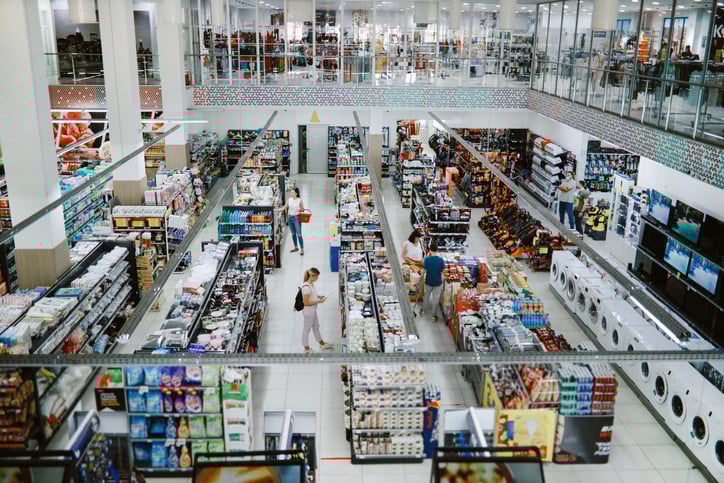
This national wholesale e-commerce brand serves nonprofits, institutions, and small businesses purchasing high-unit and bulk products across a broad catalog. Buyers arrive with high intent but complex decision requirements around pricing clarity, pack sizes, and fulfillment confidence.
## The Challenge
ClickMint’s diagnostic revealed that demand was present, but decision velocity consistently broke before add-to-cart.
Key issues included:
- Product listing pages functioning like promotional landing pages instead of shoppable categories
- Homepage navigation and category access pushed below the fold, slowing routing for diverse buyer intents
- High-unit PDPs suffering from pricing ambiguity, missing trust cues, and non-sticky CTAs
Mobile traffic represented over 40% of sessions but generated only ~2.5% of revenue—indicating systemic UX friction rather than acquisition inefficiency.
## The Solution
Rather than broad redesigns, ClickMint deployed behaviorally precise interventions engineered to resolve specific decision failure modes.
**PLP Optimization**
- Product-first layouts with reduced promo dominance
- Quick-Add functionality with clear pack and price context
- Sticky, chip-based filters and Best-Seller default sorting
- Progressive loading with curated mid-page shelves
**Homepage Optimization**
- Navigation-first above-the-fold layout
- Shortened, lighter mobile experience
- Removal of visible error states and replacement with trust/value content
- Search-aware variants for high-bounce landers
**High-Unit PDP Optimization**
- Clear per-case vs per-unit pricing language
- In-stock, shipping, and trust cues adjacent to CTA
- Sticky add-to-cart on mobile
- Pack-size alternatives surfaced above the fold
All changes were deployed through phased, statistically bounded experiments to validate impact before scale.
## The Results
Based on experiment-level projections from ClickMint’s diagnostic model, the execution roadmap is designed to deliver:
- **≈$700k** in incremental annualized revenue from PLP discovery and Quick-Add improvements
- **≈$690k–$984k** in incremental annualized revenue from homepage navigation and trust restoration
- **Low six-figure upside** from scaling high-unit PDP improvements across bulk SKUs
Collectively, this represents ≈$1.7M–$2.0M in conservative annualized incremental revenue, excluding secondary halo effects from improved mobile experience and repeat purchasing.
## Ready to get started?
[](https://info.clickmint.com/hs/cta/wi/redirect?encryptedPayload=AVxigLKIWYDorUqX8cB8xL5Vmw%2BhoSvyZ1BDSN5cLXtUTA9K44qgMfnSRkXKABE%2FYgKapNhns%2FNLWFMvw3%2FA4pBjswF4Mus6ZF0D%2BKuDIItnFTyZxpoeZq1zufnnrxWZkgW4MykNvlLSlEt%2Ffe%2B895b6vo7kuDXDCLPszl8eaVLBmj0ck1YsRjSJpz%2FUF8ozTJD3m9Miq%2FoG8RXf0cjz2OhyuiJ21K76sVcEENd0tojplUM%3D&webInteractiveContentId=293671080653&portalId=243726810&hsLang=en)
## Related case studies
[](http://clickmint.com)
- [The Platform](https://www.clickmint.com/)
- [About Us](https://www.clickmint.com/)
- [Insights](https://blog.clickmint.com/?hsLang=en)
- [Case Studies](https://info.clickmint.com/case-studies?hsLang=en)
---
Privacy Policy · Legal · © 2026 Miint Labs, LLC. All rights reserved.
**Disclaimer**
*The case studies presented reflect diagnostic findings, modeled analyses, and projected opportunity estimates based on observed user behavior and site performance at the time of evaluation. Projected revenue and performance outcomes are illustrative only and are not guarantees of future results. Actual outcomes may vary depending on implementation, traffic composition, execution, and external market factors.*